
Method
The Kanjimori Method
We break kanji down into their components and trace each character's composition through history.
Roots
Roots are the
Building Blocks of Kanji
Here at Kanjimori, we don't want you to just memorize kanji. We want to help you truly understand how kanji are built.
To do this, we'll teach you kanji through building blocks called roots. Roots are kanji or kanji components that can't be broken down into smaller components themselves. In contrast, compound characters are kanji built from these roots. Understanding how kanji are assembled from roots is called kanji composition.

All 6,000+ kanji used in Japanese are either roots themselves or built from roots, so learning to recognize roots is one of the fastest ways to accelerate your kanji learning!
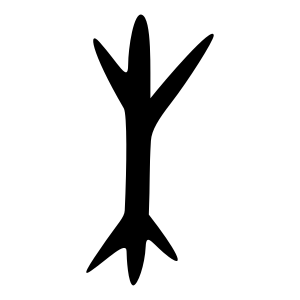
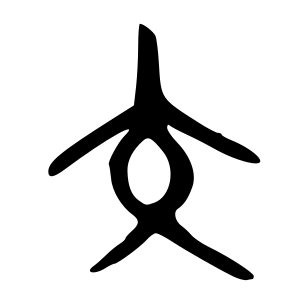
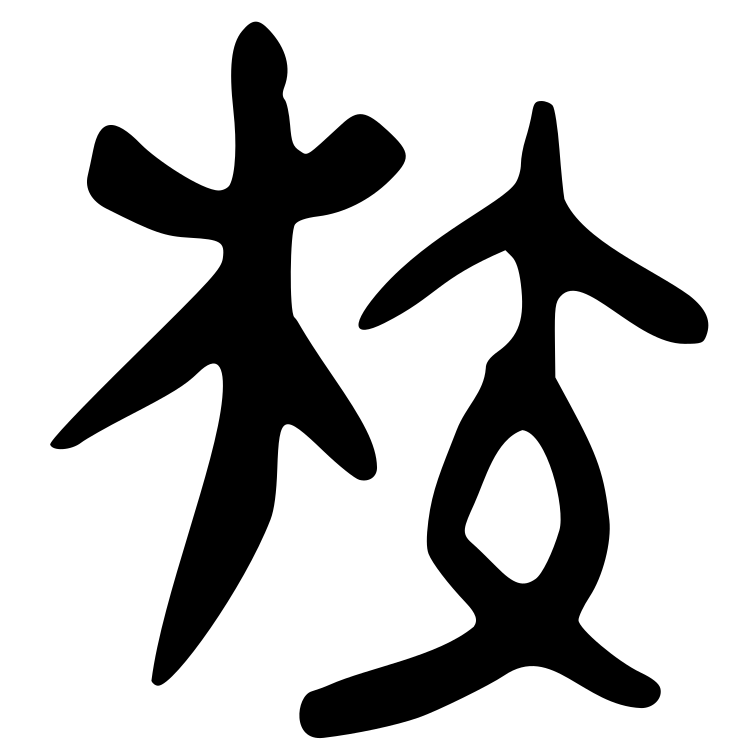
This ancestry path shows how the compound character
校 is built from two roots 木 and 交.
Kanji Composition
Kanji Composition Makes
Kanji Learning Scalable
Why learn kanji through composition rather than mnemonics? Simple! Because of scalability. Both methods improve memory by anchoring characters to associated meanings through a process called "associative learning." But while external mnemonics can help you remember an individual character through a story or image, those associations are often specific to that single kanji. This creates a largely 1-mnemonic-to-1-character relationship that becomes harder to maintain as your studies expand.
In contrast, learning kanji through composition and roots creates reusable knowledge. Once you learn a component or root, you'll start to recognize it across hundreds of other kanji that share it. This creates a 1-root-to-many-characters relationship that becomes more valuable as your knowledge grows. Kanji composition is an intrinsic part of how kanji work as a writing system, so developing the ability to recognize components and roots is an important skill at every level of kanji mastery.
In fact, around 75% of kanji are compound characters. That means learning the roughly 25% of kanji that are roots can dramatically improve your ability to recognize and remember new kanji characters.
Roots as a Fraction of All Kanji
Most kanji are compound characters,
meaning each new root learned unlocks many kanji.
Component Forms
Component Forms Reveal
Hidden Connections
In addition to roots and compound characters, we'll also teach you a type of kanji component called component forms. Component forms are different ways a given root or compound character can appear when used inside another kanji. These various forms exist because of differences in writing styles and historical simplification processes called stylization. It's similar to how the letter “a” can appear differently depending on a person's handwriting or the font being used. Rather than teaching the word “ant” written in different fonts as separate words, we teach you to recognize the different forms each letter can take so you can recognize the word regardless of how it's written.
Decoding component forms is one of the main challenges in understanding kanji composition, and it remains an active area of paleographic research today. Here at Kanjimori, we build upon existing kanji composition knowledge by conducting our own research into the origins and development of kanji characters. This allows us to provide a deeply comprehensive system for understanding how kanji relate to one another.
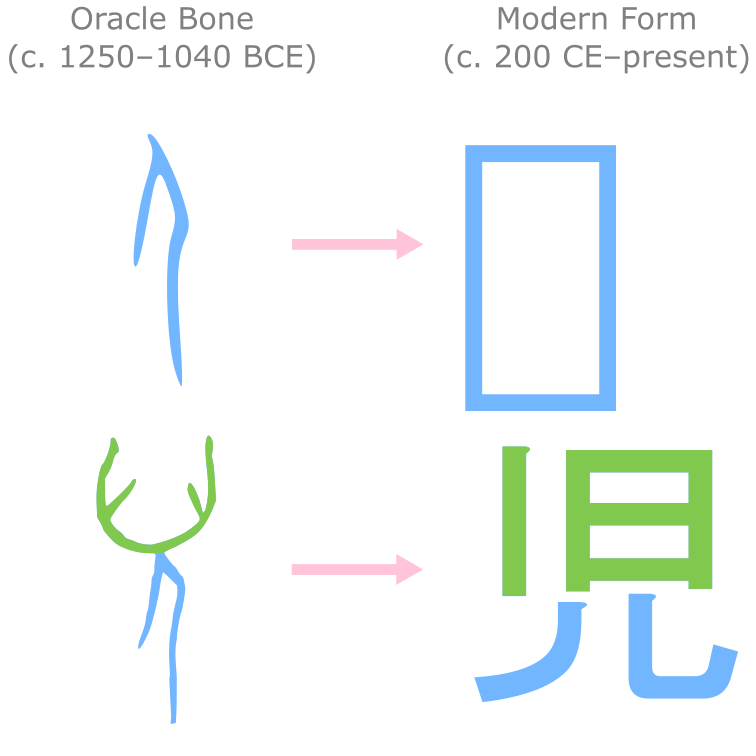
Comparing the ancient forms of 人 and 児 reveals
that the component 儿 is actually a form of 人!
Kanji Trees
Kanji Trees Visualize
the Relationships You Learn
To help visualize how kanji relate to each other, you'll grow your own set of kanji trees. Kanji trees are like family trees for kanji that connect characters through shared components. Your trees start off small but quickly grow branches as you complete more lessons and discover new connections between characters.
Kanji often inherit related meanings or similar pronunciations from the components they contain. Components that contribute to meaning are called semantic components, while components that contribute to pronunciation are called phonetic components. Recognizing these patterns makes learning new kanji much easier. If you recognize a new kanji's components, you can sometimes even infer its meaning or reading before you learn it!

Kanji Tree Gardener
Phonetic relationships are highlighted in your kanji trees to help you track which kanji have similar pronunciations. So be sure to watch for these as your trees grow!
Partial tree for the root 五 with phonetic relationships
highlighted in blue. Hover each node to see its kun-reading!
Component Categories
Component Categories
Tell a Kanji's Story
In addition to semantic and phonetic components, we also track several other component categories to help capture each kanji's development story. We use the following 7 component categories based on their role and historical presence within a character:
A component that lends the kanji a similar reading or sound.
A component that relates to the kanji's meaning.
A component that is present in the kanji both now and historically.
A component that wasn't present in the kanji historically but is now.
A component that was present in the kanji historically but isn't now.
A component that appears to be present in the kanji but arises from misparsing strokes.
A group of strokes that appears to be a component because of visual stylization but isn't one.
Every component in a kanji is simultaneously in both a role-based and a historical presence-based category. These categories are determined using the diagnostic diagrams below. Check out the site's glossary for more information on kanji component categories and examples of real components in each category.
Role Diagnostic
*In some cases, this is hard to determine based on Japanese readings because character pronunciation has drifted over time. Reconstructed Old Chinese readings are typically compared instead.